TL;DR — We watched gold prices in Kalshi, Polymarket, and the GLD options market on Cboe for a full trading day, sampling all three from free public APIs on an hourly cron. We found zero executable arbitrage; the closest miss was 2.3 cents from guaranteed profit. The two professional venues (Kalshi and GLD options) drew nearly the same probability curve all day, while the retail venue (Polymarket) was mispriced at its quoted mid-prices, but its spread ate the gap before you could trade on it. Arbitrage between these three markets is possible, but it is rare, small, and brief. Follow-up studies should look deeper than we did: we only priced the top of the book, and order-book depth or volumetric strategies are the natural next question.
On July 2, 2026, gold ran from a low of $4,030.53 to a high of $4,143.65, a 2.8% intraday range and one of its biggest single-day moves of the year. It settled around $4,123, up about 2.5% from the prior day's close near $4,024. While that happened, we pointed a small probe at three unrelated markets that all price the same thing:
- Kalshi: regulated prediction market; 40-strike ladders on "where will gold close at 5pm ET," settled on Pyth's XAU/USD feed
- Polymarket: crypto prediction market; "will gold touch $X this week/month" markets
- GLD options: the institutional gold ETF option chain, daily expiries
We've written about Polymarket's gold ladder before: a companion piece marked its prices against realized volatility and found the monthly ladder priced like an options desk while the longshots traded like a lottery counter. That piece asked whether one venue was internally consistent with reality. This one asks a different question: whether the venues are consistent with each other.
Here's the bet we were hunting for, in plain terms. Buy one Polymarket contract that pays $1 if gold ever touches $4,200 this week, and one Kalshi contract that pays $1 if gold does NOT close above a strike above that, say $4,217.99, today. Gold can't close above a level without touching it first, so whatever gold does, at least one of those two pays out. The combo is guaranteed to return at least $1, sometimes $2. If the two contracts together ever cost less than $1 to buy, that's free money, no forecasting required. We'll call this the floor bet, or the combo, from here on.
An hourly sampler ran the full scan all day: every Polymarket upside touch leg crossed against every valid Kalshi terminal leg, priced at executable asks, net of both venues' fee schedules.
The six hours Kalshi looked dead
For the first six hours of the scan, every Kalshi gold order book came back completely empty. We almost published "Kalshi gold doesn't trade" as a finding. It would have been wrong, and the bug was ours. Kalshi's newer fractional markets return prices in new _dollars fields; the legacy cent fields come back null. Our parser was reading the old fields. One diagnostic call against a single strike showed the at-the-money contract had actually traded at 96 cents, with live quotes and 759 contracts of open interest sitting right there. We fixed the parser and the "dead" market turned out to be one of the most liquid rungs on the ladder.
Finding 1: no free money, but we can tell you the exact margin
Across every US-session run, no combination ever cost less than $1.00 net of fees. The closest approach, at 16:28 UTC: Polymarket's touch-$4,200 at a 4.3¢ ask plus Kalshi's weekly close-above-$4,217.99 NO at 98¢, total $1.023. That's 2.3¢ gross, 2.7¢ net of fees, away from free money.
| Run (UTC) | Priceable pairs | Best pair's net edge |
|---|
| 13:28 | 8 | −25.3¢ |
| 15:28 | 8 | −4.3¢ |
| 16:28 | 8 | −2.7¢ |
| 17:28 | 8 | −2.8¢ |
| 18:28 | 3 | −18.1¢ |
| 19:28–20:28 | 0 | quotes pulled into settlement |
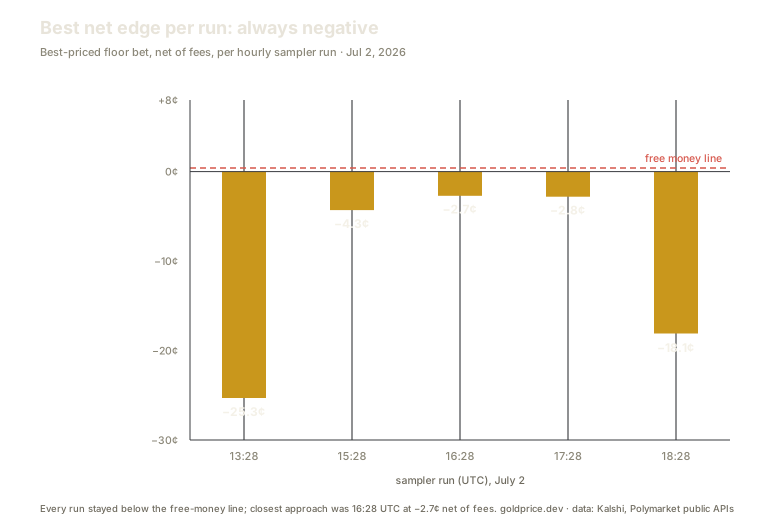
Two things cap the opportunity even on the runs where the gap gets close. First, Polymarket's touch books are thin, 8 to 96 contracts at the ask all afternoon, so even a hit would be lunch money. Second, Kalshi's fee schedule (roughly 7¢ × p × (1−p) per contract) eats most of any edge under 3¢. "The market is efficient" is usually an assumption. Here it's a measurement, and now you know the margin.
Finding 2: Kalshi's ladder matches the options market, and there's a concrete reason why
At mid-afternoon we compared the implied probability of every gold close level across venues.
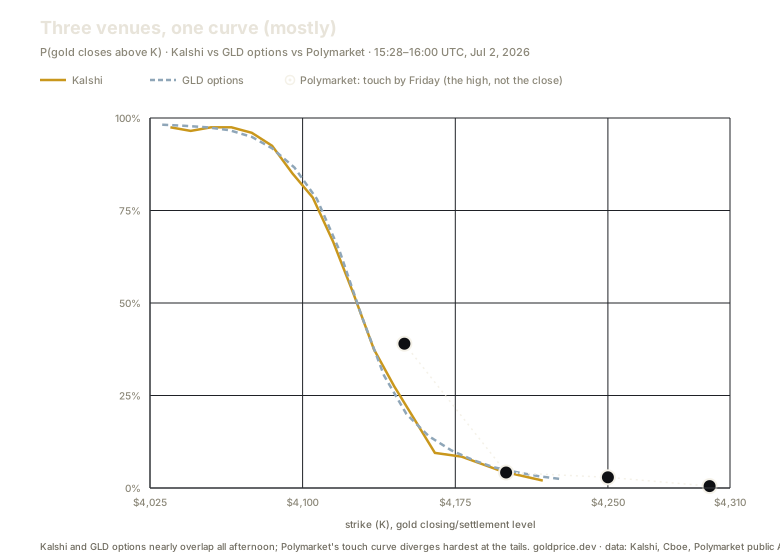
Kalshi's 40-rung ladder and the GLD option chain (deltas / call-spread digitals) agreed within a few percentage points across the entire strike range. Two venues, two regulators, and they draw almost the same curve.
It's tempting to read this as "wisdom of crowds matches Wall Street." It isn't, and the reason is more specific than that. Kalshi's commodities markets settle on Pyth's XAU/USD feed, a confidence-weighted median of institutional publishers with LBMA/COMEX/OTC access, updating every 50ms. Pyth Pro is the exclusive data layer for Kalshi's Commodities Hub, and Kalshi's liquidity providers get direct access to that feed. Kalshi's designated market maker is Susquehanna, one of the largest options trading firms in the world. The prediction market and the option market agree because, underneath the wrappers, they're substantially the same institutional complex quoting the same reference price.
The residual differences are the interesting part: a small systematic tilt, since Kalshi observes 5pm ET, an hour after the ETF close, so there's an extra hour of possibility baked in. And the prediction market side carries fatter tails at the far strikes.
What this means practically: a Kalshi gold ladder is a readable, institutional-grade implied probability distribution, published every day, from a free public API. During US hours we measured 1–3¢ spreads at the money and open interest of 1,000–4,900 contracts per rung.
Finding 3: the retail venue leaks, and the spread is exactly the size of the leak
Polymarket is the genuinely retail curve in this trio, and it showed. Mid-afternoon, its touch-$4,200 traded at a 4.2¢ mid while Kalshi priced close-above-$4,198 at a 4.5¢ mid. The market that only needs gold to touch $4,200 anytime before Friday was priced below the market that needs it to close above $4,198 the same day. As probabilities, that ordering can't be right.
So why wasn't it free money? Because you can't trade at mids. Buying the touch cost 5.8¢ at the ask; the executable combo landed at $1.02–1.04 all afternoon. The arbitrage existed at mid prices and died in the bid-ask spread.
What this adds up to
Yes, arbitrage between these venues is possible in principle, and we came within 2.3 cents of seeing it happen. In practice it's rare, it's small (Polymarket's books cap any hit at 8 to 96 contracts, lunch money), and it's short-lived. Nobody publishes how far apart these markets sit from minute to minute. We think that gap, tracked over time, is worth more than any single day's near-miss.
For the year-end horizon, we didn't build a third chart here: we took Polymarket's December tails apart in a companion piece. Kalshi's own year-end ladder, for context, priced 46.5% above $4,300 and 19.5% above $4,800.
Reproduction notes (the traps)
Everything here uses free, public, no-auth endpoints. All of these will cost you an afternoon each if you don't know them:
- Kalshi's fractional markets return quotes in
*_dollars/*_fp fields; the legacy integer-cent fields are null. Empty-looking books may just be a parser bug, not a dead market.
- Kalshi gold books are empty outside US hours, sample 13:00–21:00 UTC.
- Kalshi offsets weekly strikes by $.99 ($4,217.99 vs Polymarket's $4,200), exact-strike joins never match; the dominance construction doesn't need them to.
- Polymarket touch markets come in ↑HIGH and ↓LOW variants, only HIGH legs (strike above spot) form valid floor-bet pairs.
- Polymarket's GC-labeled markets settle on CME futures, not spot, a different underlying (spot, futures, and settlement are three different numbers); exclude them from these constructions.
- Kalshi API is TLS-fingerprint/geo restricted, run collectors from a US datacenter IP.
What's next
The curves in this post are snapshots. Goldprice's hosted probability-surface product has been retired. The same idea now lives in gold-prediction-stream, an independent MIT-licensed open-source reference project that combines goldprice.dev spot data with public Kalshi and Polymarket ladders. It is not part of the goldprice.dev API, MCP server, paid plans, or hosted product.
Charts in this post are powered by the same public data. Nothing here is investment advice; contract fees, geo-restrictions, and venue terms apply. Data: Kalshi and Polymarket public APIs, Cboe delayed option quotes.
Not financial advice. Prices as of 2026-07-02, sampled 13:00–21:00 UTC.