Can you predict the gold price?
What the 2023–2026 research actually says about forecasting gold: the model that worked for a decade, why it broke, and how to test any claim yourself.
Read →We priced all 24 live Polymarket gold contracts against spot and realized volatility. The monthly ladder trades like an options desk; the longshots trade like a lottery counter, and the premium grows with distance.
TL;DR — On July 2, 2026 we marked all 24 live Polymarket gold contracts against spot gold ($4,068.53) and realized volatility (23.6–28.1%). The liquid July ladder is priced remarkably well: 11 of 12 strikes inside a deliberately generous model band, implied vols 19–32% sitting right on top of realized (the twelfth missed the band floor by a hair — on the cheap side). The mispricing lives in the longshots, and it grows with distance: this week's deep out-of-the-money strikes trade at 2–5× fair value, and the December tails leave the planet. "Gold hits $10,000 by December" trades at 4.1¢ but needs 62% volatility to be fair. "$15,000" trades at 3¢ and needs 85%, roughly three times what gold has actually done.
A recent working paper on the Kalshi prediction market (Bürgi, Deng & Whelan, 2026) found that prediction-market longshots are systematically overpriced: contracts under 10¢ lost more than 60% of the money wagered on them across four years of data. They had to wait for 313,972 contracts to resolve to show that.
Gold gives us a shortcut. A "will gold hit $X" contract is a digital option on an underlying with a live, deeply traded reference price. You don't need to wait for resolution to know what the contract should cost. You can compute it, today, from spot and volatility. So we did. (Whether anyone can predict gold's direction is a different question, covered in Can you predict the gold price? — this piece is about something more tractable: whether quoted probabilities match the volatility gold actually delivers.)
Polymarket runs strike ladders on gold: monthly ("What will Gold hit in July 2026?", 14 strikes from $3,300 to $4,600), weekly, and a year-end ladder on front-month gold futures ("What will Gold (GC) hit by end of December?", strikes to $15,000).
Resolution mechanics matter here, so we read the fine print. The monthly and weekly XAUUSD ladders resolve on 1-minute candles: "hit $4,400 in July" pays out if gold trades there for one minute. Those are true touch options, and under a driftless model a touch probability is exactly double the terminal probability for the same strike (the reflection principle) — any comparison that ignores this overstates mispricing by 2×. The December ladder is different: it resolves on the official daily futures settlement price, a barrier checked once per trading day, not continuously (spot, futures, and settlement are three different numbers). Our continuous-touch formula is therefore an upper bound on the December contracts' fair value — whatever gap we find there is understated, not overstated.
The model: driftless lognormal, P(touch) = 2·N(−|ln(K/S)|/σ√τ). Inputs, all from July 2 around 12:20 GMT:
Honestly, we expected the Kalshi result everywhere. That's not what the data says. Here is the full July ladder, every unresolved strike:
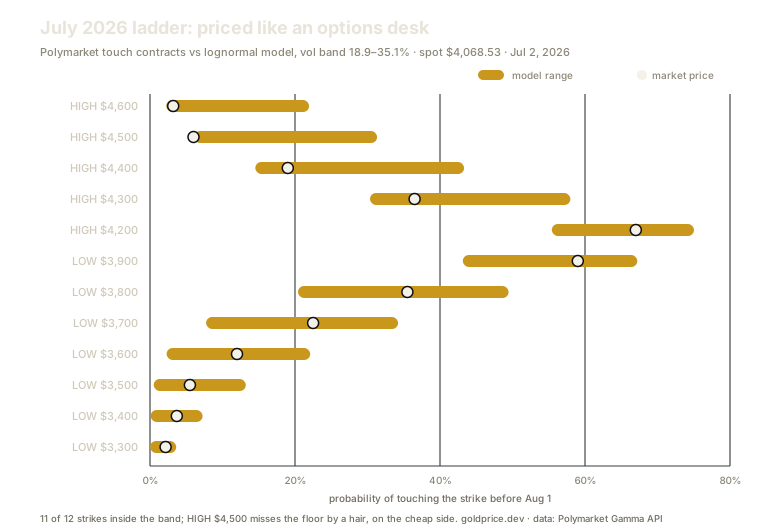
Eleven of twelve strikes sit inside the band. The twelfth, HIGH $4,500, misses the band's floor by less than a tenth of a cent — and it misses cheap, the opposite direction from a lottery premium. Read the implied vols: 19–21% on the upside strikes, rising through 26–32% toward the deep downside. Every strike prices gold's volatility within a few points of what gold actually delivers, and the shape is a coherent smile (downside priced over upside, which is how real options markets treat gold too). Whoever is making these markets is doing real work. This ladder would not embarrass an options desk.
The same snapshot includes a weekly ladder expiring in under two days, and this is where the longshot tax first appears:
| Week of Jun 29 strike (touch) | Market | Model range | Verdict |
|---|---|---|---|
| HIGH $4,250 | 2.6¢ | 0.02–4.2% | within band |
| HIGH $4,200 | 7.4¢ | 0.6–13.7% | within band |
| HIGH $4,150 | 17.5¢ | 8.5–35.4% | within band |
| LOW $3,900 | 5.0¢ | 0.02–4.8% | rich, barely |
| LOW $3,850 | 1.75¢ | 0.0–1.0% | ~2× fair value |
| LOW $3,800 | 0.75¢ | 0.0–0.14% | ~5× fair value |
The pattern is a gradient, not a cliff: the closer a contract sits to "lottery ticket," the further its price drifts above fair value. At $3,900 the premium is marginal. Two strikes further out it's 5×.
Now the December GC ladder, same method, same band — remembering that for these daily-settlement contracts our model overstates fair value, so every gap below is conservative:
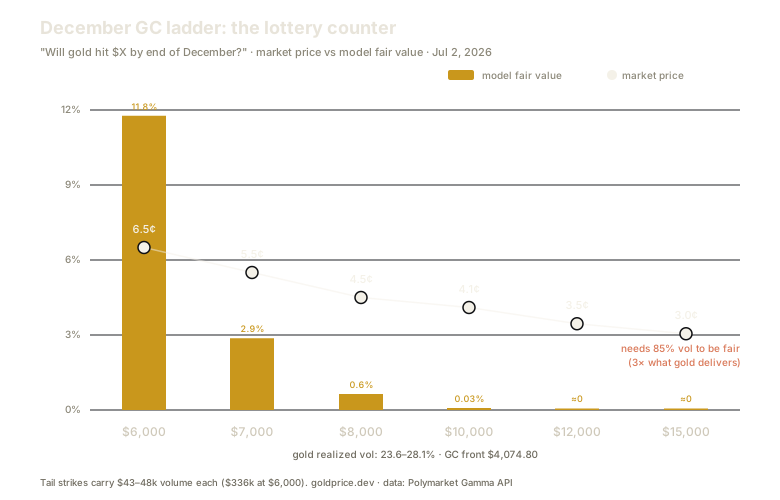
The market's prices fall from 6.5¢ to 3¢ across strikes whose real probabilities fall by several orders of magnitude. For $15,000 to be fair, gold would need to sustain 85% annualized volatility for six months, three times its realized level, on its way to nearly quadrupling. The quote is 3¢ anyway. And these aren't dead markets: the tail strikes carry $43,000–$48,000 of volume each, $336,000 on the $6,000 strike.
This is the favorite–longshot bias from the Kalshi paper in its purest form, measurable in a single snapshot because the underlying has a real price. Buyers of these contracts are paying 4¢ for lottery tickets worth a fraction of a cent.
Why doesn't someone sell them down to fair value? The paper's authors gave three reasons for Kalshi: volumes too small for professionals to bother with, payoff variance that punishes even correct sellers, and simple unawareness — most participants don't know the bias exists. The first two transfer directly. But there's also a cleaner floor here: shorting a 3¢ contract ties up 97¢ of collateral for six months to earn about 3% — call it 6% annualized, only modestly above what the same stablecoin earns sitting in a lending market. Below ~3–4¢, selling longshots stops clearly beating the boring alternative, so nobody bothers. The lottery premium isn't just irrationality; it's priced up to roughly the level where correcting it stops paying. As for the third reason — unawareness — publishing the mark-to-reality is the fix, and that's what this post is.
Every number in the anchor leg of this study — spot, and the daily history behind the vol estimate — is the kind of data goldprice.dev serves over one authenticated endpoint, with per-source provenance (methodology). If you want to run this yourself, the whole thing is ~80 lines of Python: pull a gold ladder from Polymarket's public API, pull spot and daily history from us, and apply the touch formula above. Marking a prediction market against reality is a one-afternoon project when the reference price is an API call away.
References: Bürgi, C., Deng, W., & Whelan, K. (2026). Makers and Takers: The Economics of the Kalshi Prediction Market. UCD working paper. PDF · Polymarket gold ladders: monthly / year-end GC
Not financial advice. Prices as of 2026-07-02 ~12:20 GMT and moving while you read this.
related guides
What the 2023–2026 research actually says about forecasting gold: the model that worked for a decade, why it broke, and how to test any claim yourself.
Read →Why sovereign reserve managers have been accumulating gold at record pace, and the mechanics of how that demand affects prices.
Read →Real interest rates, the US dollar, inflation expectations, central-bank demand, and risk-off flows: the mechanisms behind gold's moves, and which ones matter most.
Read →goldprice.dev
Live gold prices, historical OHLC, and multi-source aggregation — available via REST and SSE.